

TL;DR
Building location pages by duplicating the same content for multiple towns with minimal changes and mixing many services on one page leads to poor SEO results and risks Google penalties.
- Location pages should be focused on specific services combined with real local details to rank well.
- Duplicating pages with only city name swaps violates Google’s doorway abuse policy and can hurt rankings.
- Cheap SEO shortcuts that create many broad, similar pages often lead to costly fixes later.
Quick win: Create targeted service-and-location pages with unique, genuine local content instead of generic, broad town pages.
We recently came across the website for Fast Fix Garage Door. Because we eat, sleep, and breathe this stuff (so you don’t have to), a few glaring SEO problems jumped out at us right away.
The goal here is not to pick on Fast Fix. In fact, this looks much more like a business being steered down the wrong path by bad or outdated marketing advice.
That is exactly why their site makes such a useful real-world example. By walking through what went wrong, we can show other small business owners what to watch for, why these mistakes matter, and how to avoid paying to fix the same website twice.
One Page Cannot Be Everything to Everyone
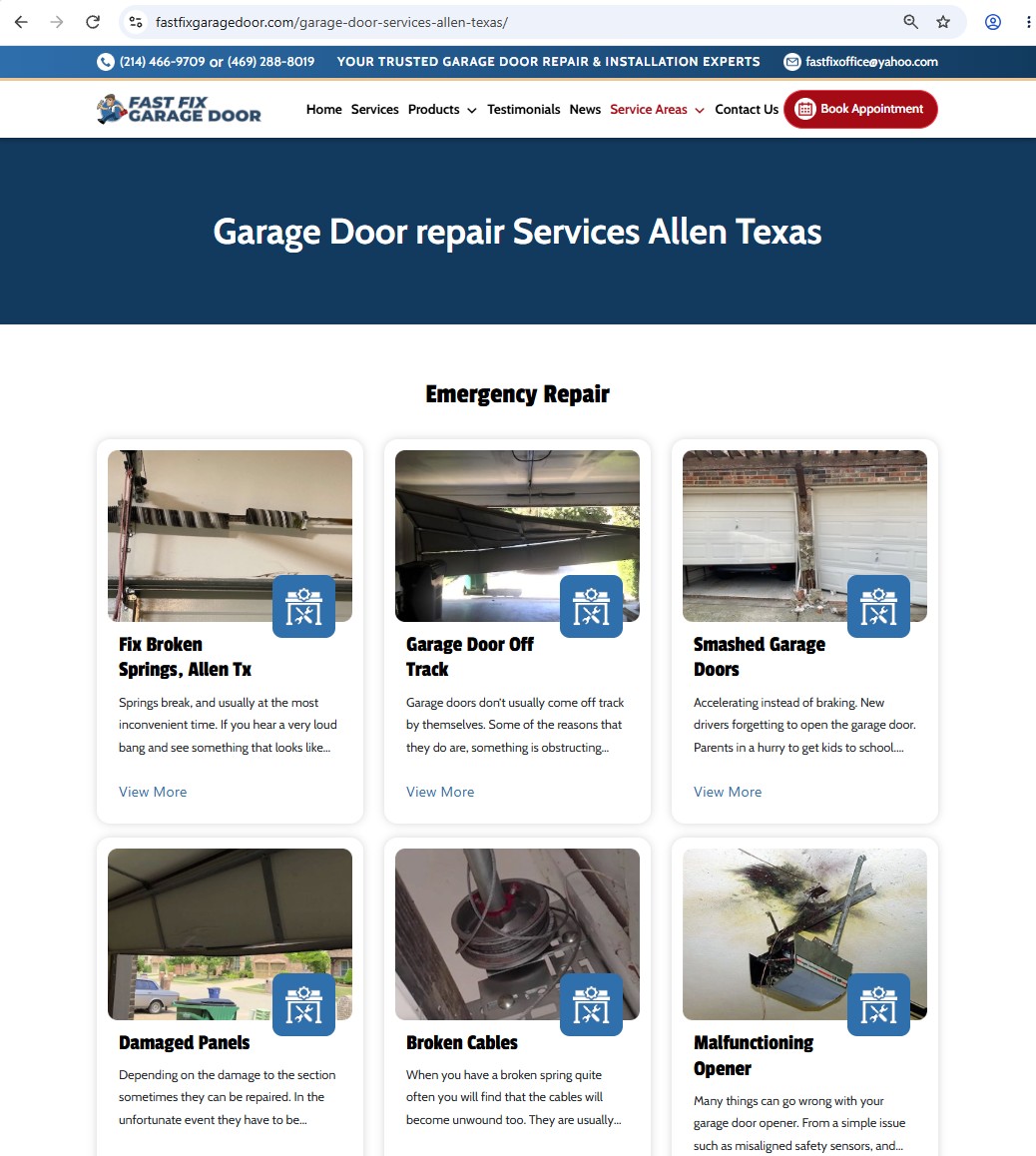
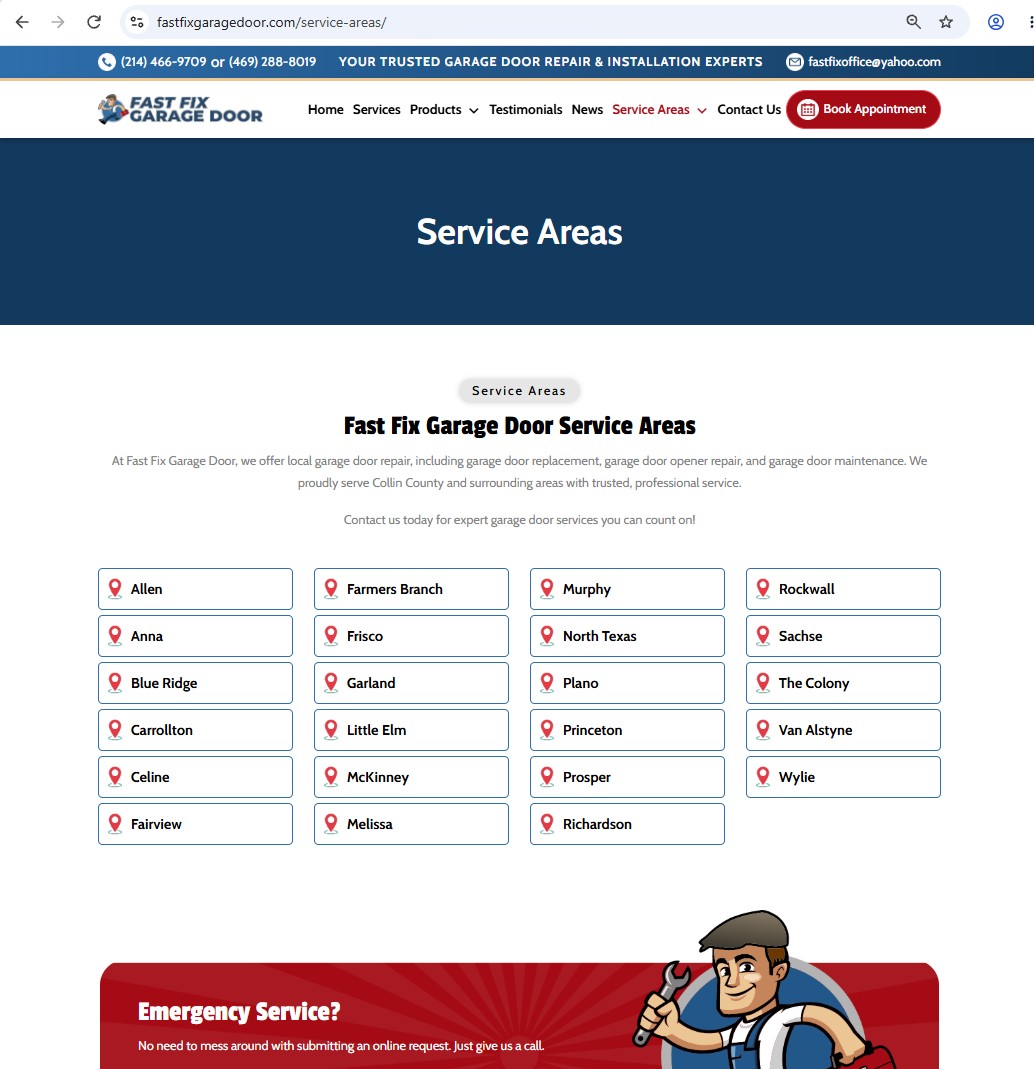
Fast Fix has location pages for more than 20 communities, including Allen, Anna, Plano, Frisco, McKinney, Richardson, and Wylie.
But instead of giving important services their own focused pages, each town page tries to cover nearly everything the company does.
Take the Allen page. It talks about:
- Off-track garage doors
- Smashed doors
- Damaged panels
- Broken cables
- Garage door openers
- Broken springs
- Different spring systems
- New installations
So what is this page actually about? If I need a broken spring replaced, why am I reading about damaged panels, openers, cables, installations, and a bunch of other problems I do not have? That is not just an SEO problem. It is a customer problem too.
Customers searching for “garage door spring repair in Allen, TX” don’t want to have to sift through a page with off-track repairs, new installs, and broken cables. They don’t have those problems. They want a page that immediately tells them:
- Do you handle garage door spring repair?
- Do you service Allen, TX?
- Are you trustworthy?
Google has the same interest. It’s trying to match each search to the most relevant answer. A page that stays focused on the exact service and location is a much clearer match than a catch-all page trying to rank for everything at once.
Lack of focus means a weaker match. A weaker match makes ranking harder and gives the customer a less useful page.
Start With Strong Service Pages, Not a City-Page Factory
The fix is not to take every service, multiply it by every town, and publish 200 new pages. That would just create a different version of the same problem. The order matters.
First, build strong core pages for the services that matter most.
For a garage door company, that might include:
- Garage Door Spring Repair
- Garage Door Opener Repair
- Garage Door Installation
- Garage Door Cable Repair
- Garage Door Panel Repair
- Garage Door Off-Track Repair
Those pages give each major service a clear home on the website.
Second, selectively build service-and-location pages where there is a real reason to do so.
For example:
- Garage Door Spring Repair in Allen, TX
- Garage Door Opener Repair in Allen, TX
- Garage Door Spring Repair in Plano, TX
- Garage Door Installation in Plano, TX
Now each page has one job.
Each spring-repair page can focus on broken springs, warning signs, replacement options, common spring systems, and real spring-repair work completed in that town.
Each door opener page can focus on opener failures, repair versus replacement, brands, smart openers, and actual opener work completed locally.
But only build those pages when you have enough business activity in that area and real local information to support them. If you have nothing meaningful to say about a particular service in a particular town, you probably do not need that page.
The Find-and-Replace Problem
The second issue becomes obvious when you compare Fast Fix’s city pages side by side.
Open Allen. Then Anna. Then Garland. Then Prosper. (Feel free to keep going if you love repetitive tasks…)
You see the same services, the same structure, and large portions of the same wording.
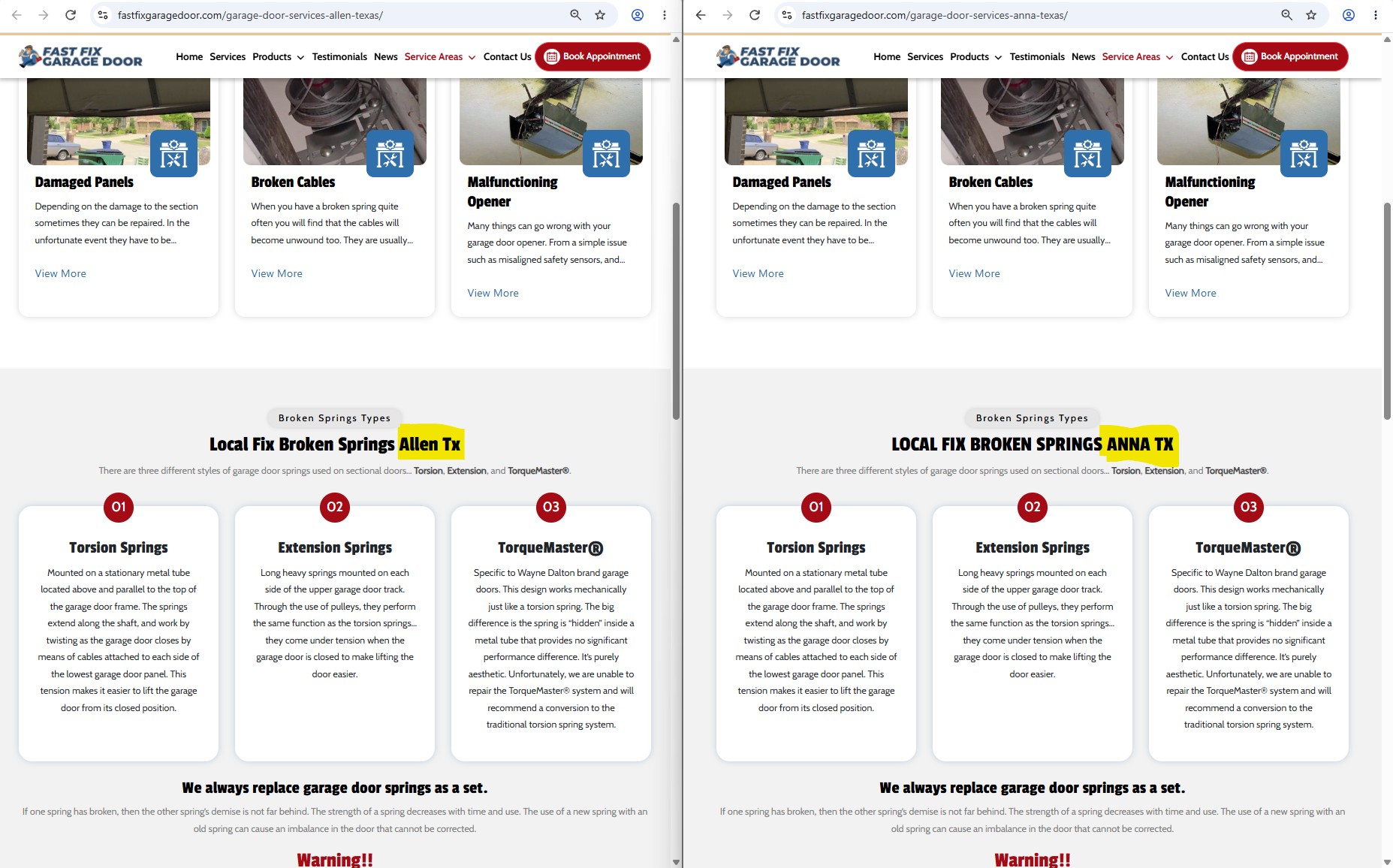
The city name changes, but much of the page does not.
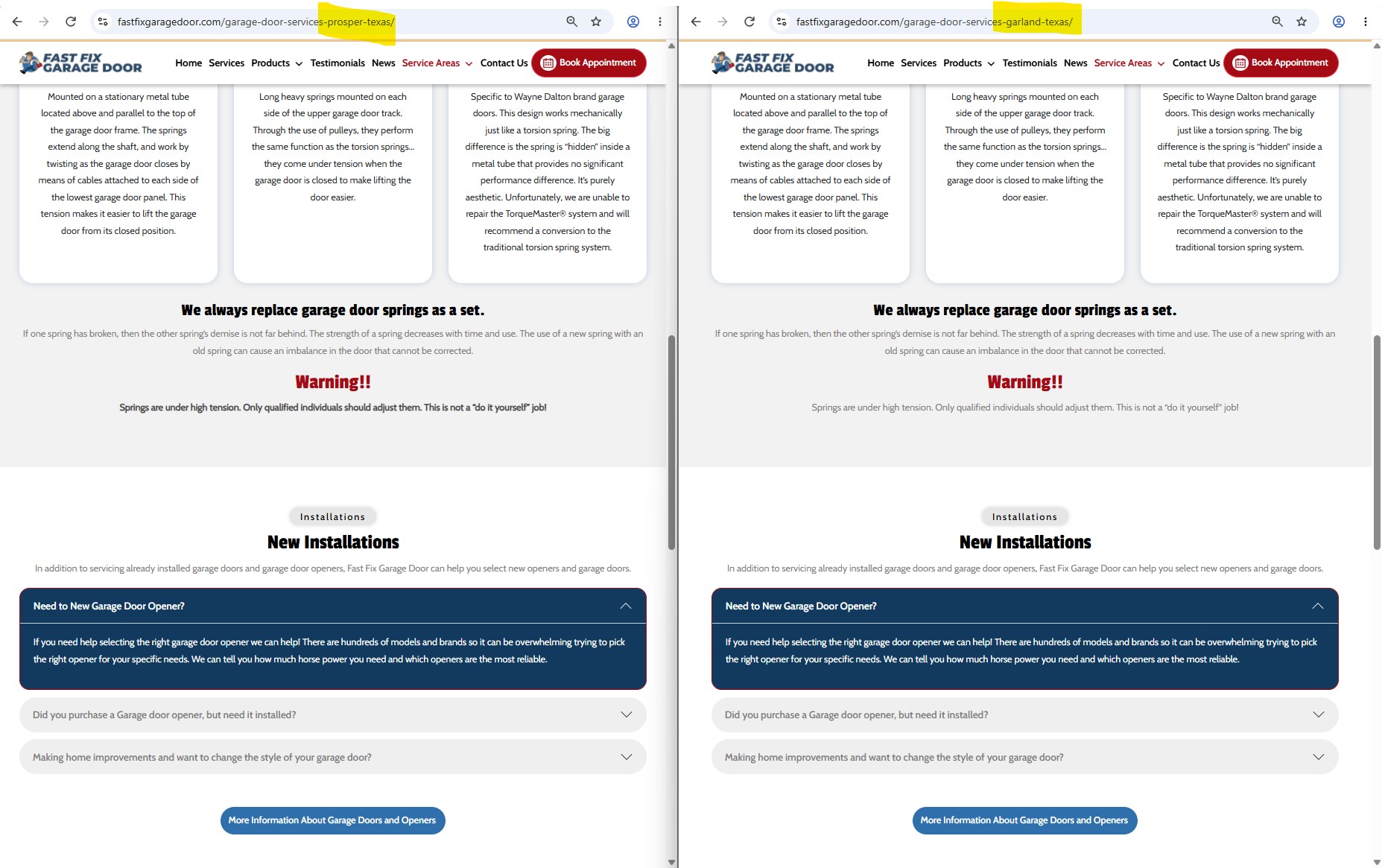
That is not really four useful pieces of local content. It is one page wearing four different nametags.
This is the test we have recommended before in our article, How to Build Location Pages That Help You Rank, Not Drag You Down:
Could you replace the town name and use the page somewhere else without substantially rewriting it?
If the answer is yes, the page probably is not local enough.
This Is the Kind of Pattern Google Warns About
This is not just our opinion about how location pages should be built.
Fast Fix’s pages have several characteristics Google specifically warns about in its doorway-abuse policy.
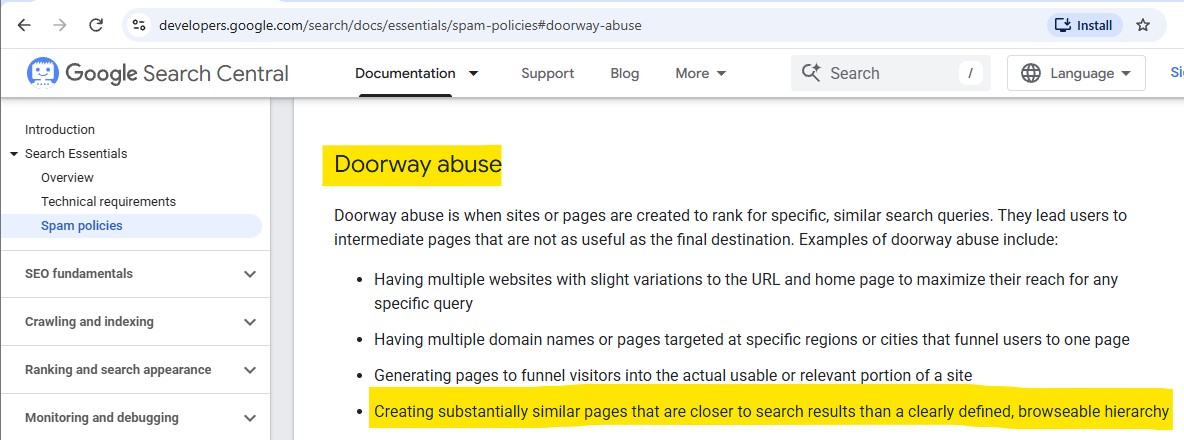
Google warns about substantially similar pages created to rank for closely related searches, including pages targeted at different regions or cities.
That does not mean we can declare that Google has formally judged Fast Fix’s pages to be doorway abuse. We cannot know that.
But a large collection of very similar city pages created around the same services has clear similarities to the pattern Google tells site owners to avoid.
Google also has a policy covering scaled content abuse, which addresses large amounts of content created primarily to manipulate search rankings rather than help users.
Again, we cannot know the intent behind these pages, so we would not automatically label them scaled content abuse.
But if your marketing strategy is essentially “duplicate this page 25 times and replace the town name,” you should be paying very close attention to what Google is saying.
Cheap SEO Creates an Expensive Cleanup
Here is where this becomes a business problem, not just an SEO problem. This kind of strategy is cheap to produce, especially with AI. Build one template. Duplicate it. Change “Allen” to “Anna.” Duplicate it again. Change “Anna” to “Plano.” Keep going. Suddenly the client has 25 new “SEO pages,” and the project looks impressive on an invoice.
But this kind of pattern runs directly into the types of practices Google warns about, which can create a costly cleanup later.
That can mean paying another company to:
- Audit all of the existing pages
- Figure out which URLs have any value
- Build the missing core service pages
- Rewrite worthwhile location content
- Remove or consolidate weak pages
- Create redirects
- Repair the internal linking structure
- Monitor traffic and rankings during the transition
You paid someone to build it. Now you are paying someone else to take it apart and rebuild it properly.
That is technical debt, which we discussed in our article about Google’s June 2026 spam update.
The bargain SEO did not save money. It postponed the bill and made it bigger.
What Makes a Location Page Worth Having?
A city name does not make a page local.
A useful location page should show that the company actually works in that market and has something meaningful to say about serving customers there.
That might include:
- Real jobs completed in that town
- Photos from local projects
- Reviews from local customers
- Neighborhoods regularly served
- Common service problems seen in that area
- Examples of the types of homes, equipment, or systems commonly encountered there
- FAQs based on questions local customers actually ask
That information is useful for the customer because it answers the questions they actually care about:
- Do you fix my problem?
- Do you work in my town?
- Have you done this kind of work nearby?
- Can I trust you to handle it?
It also gives Google a more specific page to evaluate.
A good location page should make those answers obvious.
Choose Value, Not Just the Lowest Bid
We do not know who built Fast Fix’s website or what advice they were given. That is why the lesson here is not “Fast Fix did something stupid.” The lesson is that small business owners need to vet the people they trust with their marketing. Price matters. But cheapest and best value are not the same thing.
Before hiring an SEO company, ask them:
- Why does each page need to exist?
- How will one location page differ from another?
- Will my important services have their own pages?
- What real local information will you use?
- Can you show me examples of similar work?
- How does this strategy line up with Google’s published policies?
A good marketing partner should be able to explain the strategy in plain English. If the pitch amounts to “we’ll create a bunch of pages with your keywords and town names,” keep shopping. Paying a little more for someone who knows what they are doing is a much better deal than paying the cheapest company first and the right company second.
Location Page FAQs