
TL;DR
Your Google Business Profile hours directly impact when your business appears in search results. Accurate, real hours help Google show your business when customers search. False or inaccurate hours can lower visibility and frustrate customers.
- Google uses business hours to decide when to show your profile in search results.
- Listing hours you cannot genuinely support risks bad reviews, edits, or suspension.
- Extending real availability with call routing tools like CallTrax helps keep hours accurate without overpromising.
Quick win: Use call routing technology to automatically direct calls based on time, allowing you to extend real availability and keep your listed hours truthful.
Imagine this. You set your business hours to something perfectly reasonable, like 9:00 to 6:00. Then at 8:00 p.m., someone searches for exactly what you do, and you are nowhere to be found.
Not because your reviews are bad. Not because your website is weak. Not because another business is better.
Because your profile says you’re closed.
That is the part most business owners miss. Your hours are not just a line of profile data. They help Google understand when your business is available, and Google explicitly tells businesses to keep their hours accurate and up to date.
Why would Google care? Because Google’s job is to recommend businesses that can actually help the searcher right now. If someone searches at 8:00 p.m., a business that appears open is often a better candidate to satisfy that search than one that appears closed.
That does not mean Google will never show a closed business. But when your profile says you’re closed, Google has a clear signal that you’re unavailable, which can reduce your chances of appearing for searches happening at that time.
Why the obvious fix can turn into a bigger problem
Once owners realize this, the temptation is obvious. Just mark the business open longer. Maybe go all the way to 24/7. To be fair, there is logic to that. If closed hours reduce your chances of showing up, then broader hours can increase the amount of time your business stays eligible to appear.
That is why 24/7 coverage can work for the right business. But only if the availability is real, and only if your listed hours match what a reasonable customer would expect. If your profile says you are open, someone should be able to respond in a meaningful way when that customer calls, visits, or reaches out.
How it goes wrong
- You list hours that are not real.
- Maybe you set the profile to 24/7 because you want to show up at all hours. Or you stretch your schedule beyond when anyone actually answers the phone. Maybe you run a pin-drop location and mark it open even when nobody is there.
- Someone trusts the listing.
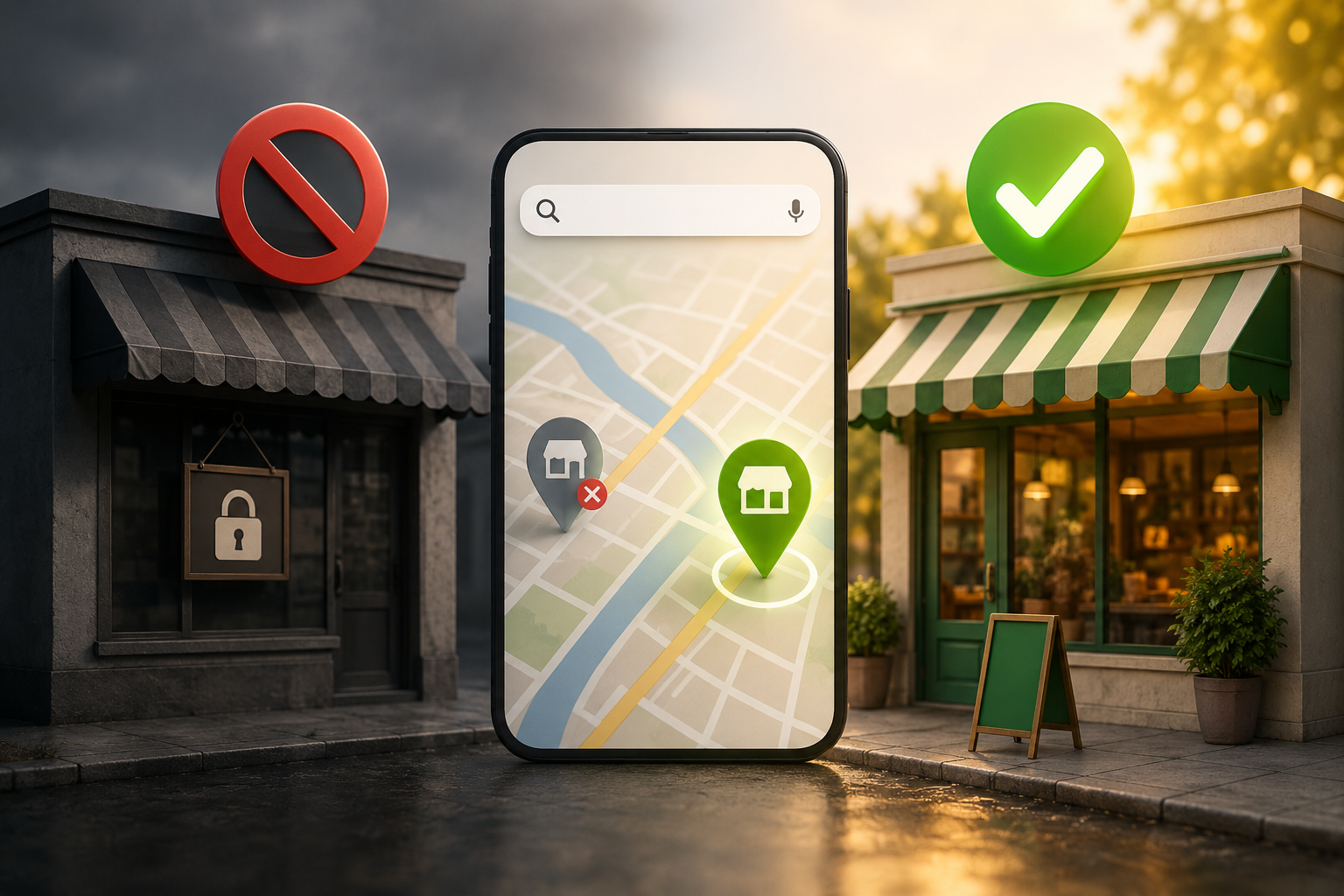
- They call and get no answer. Or worse, they drive over because Google says you are open, and they find a locked door.
- Frustrated, they report the bad information in the Google app, and maybe leave a bad review.
- Google makes it easy for users to suggest edits to business details like hours or mark a place as closed. That report might come from the disappointed customer, another Maps user, or a Local Guide.
- Google may simply update the listing info. Or, they might move right to suspending your listing.
- Sometimes Google changes the hours or updates the listing without asking you. More serious or repeated policy violations can lead to restrictions or suspension.
This is an easy situation to create. Once your listed hours and real-world availability stop matching, you introduce the kind of inconsistency Google is trying to correct.
How to fix it without faking your hours
The answer is not to lie about being open. The answer is to expand your real availability.
For a lot of small businesses, that starts with one simple question: when can someone actually respond to a lead in a way that matches what a customer would reasonably expect?
If the phone can be answered earlier, later, or on weekends, your hours may be able to expand with it. That does not mean the owner has to personally pick up every call. It means the business has a real way to respond when a customer reaches out.
That is where a system like CallTrax can help. Instead of keeping the same call routing all day, CallTrax lets you change where the phone rings based on the time of day and day of week. Calls can go to the office during business hours, then route to an answering service, on-call staff member, or another number when the schedule changes.
The call routing changes automatically based on the schedule you set.
That gives you a practical way to extend availability without forcing one person to stay glued to the phone all day and night. It also makes it easier to match your listed hours to your actual ability to respond.
For some businesses, that means extending into evenings and weekends. For others, especially service-based businesses, it can make 24/7 coverage realistic when paired with an answering service or AI phone assistant.
The key is simple: only list the hours you can actually support. If your business can genuinely respond during those hours, then you are not gaming the system. You are making your availability match reality.
Who needs to be especially careful
This is especially important for pin-drop locations.
If customers can physically visit your address, your hours need to reflect when someone is actually there. If your listing says open and people keep finding the place empty, that is not a small detail. That is a direct mismatch between your profile and reality.
For service-area businesses, there is usually more flexibility. If nobody is coming to your address and you can genuinely answer the phone or handle leads after hours, then broader hours may make sense.
The practical rule
Use the widest hours you can honestly support.
If you can truly answer calls or handle inquiries 24/7, list 24/7.
If you have a public location, only list hours when someone is physically there.
If you cannot support around-the-clock availability, do not pretend you can.
Every hour you list sends Google a signal. Make sure it is a true one. The goal is not to look available. It is to actually be available whenever your profile says you are.
Google Business Profile FAQs