
TL;DR
Fake reviews generated by AI are a bad idea: they fail with search systems, they fail with real people, and they can create legal exposure under recent FTC rules.
- Fake reviews and AI-generated fake reviews usually provide little or no SEO value and can make a site look staged or manipulative.
- Fake reviews damage trust because visitors spot templated or staged on-site testimonials more easily than real third-party reviews.
- The FTC’s rule effective October 21, 2024 covers deceptive review practices and can apply civil penalties for knowingly posting fake reviews or misrepresenting reviews.
Quick win: Get real reviews from real customers, ask consistently and soon after the job is done, and make it easy for customers to leave feedback on third-party platforms.
We have been seeing a frustrating pattern lately. Some small businesses are trying to use AI to generate fake customer reviews, then treating those reviews like they belong on a company website.
That is a bad idea for all the obvious reasons. It is dishonest. It is misleading. And as of October of 2024, it may also be illegal (more on that later).
As we’ve explained in the past, If It’s Easy to Do, It Probably Has Little SEO Value. If something is easy to produce in bulk, there is usually very little value in it. If there is no barrier, there is no advantage. And if anyone can churn it out by the hundred with a simple prompt, it is not a meaningful trust signal.
The screenshots tell the story
In this recent case, a business owner asked ChatGPT to generate fake Google reviews.
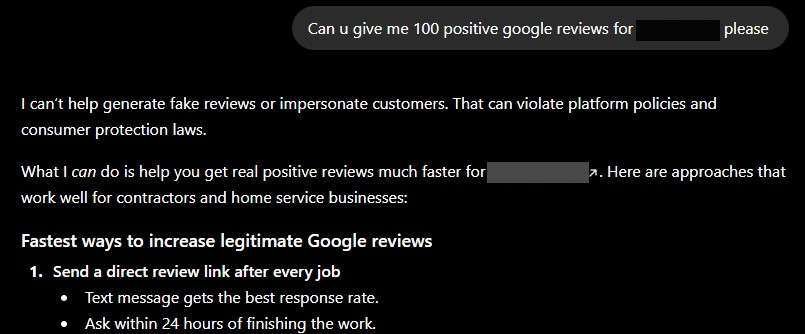
ChatGPT refused and pointed him toward the honest approach: get real reviews from real customers.
He then tried to slip around that by asking for “sample reviews,” as though changing the label somehow changed the idea. It did not. He got a batch of glowing, generic testimonials and apparently thought that was some clever solution.
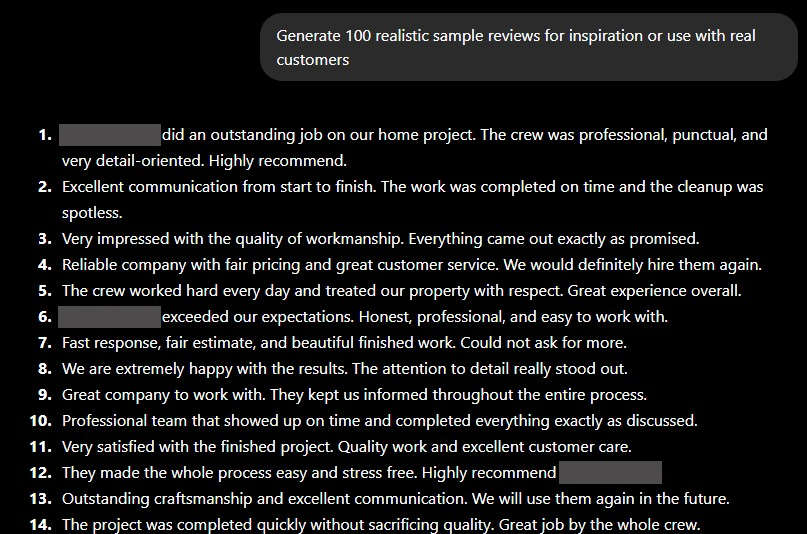
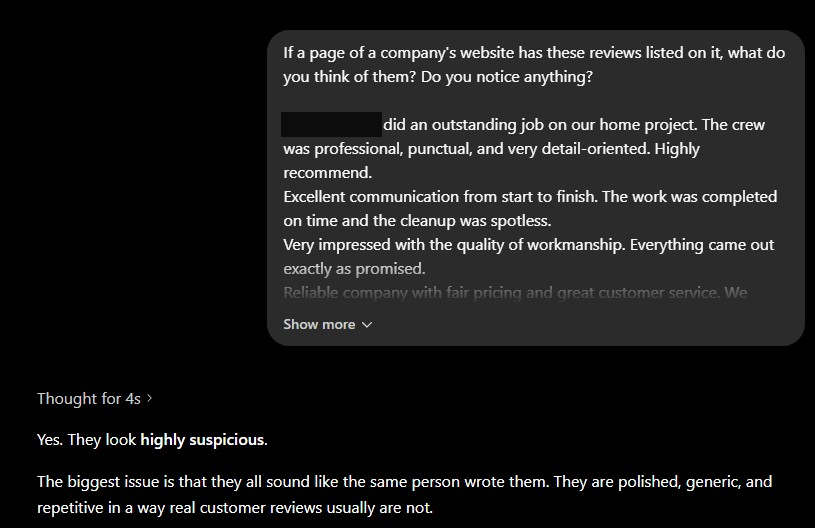
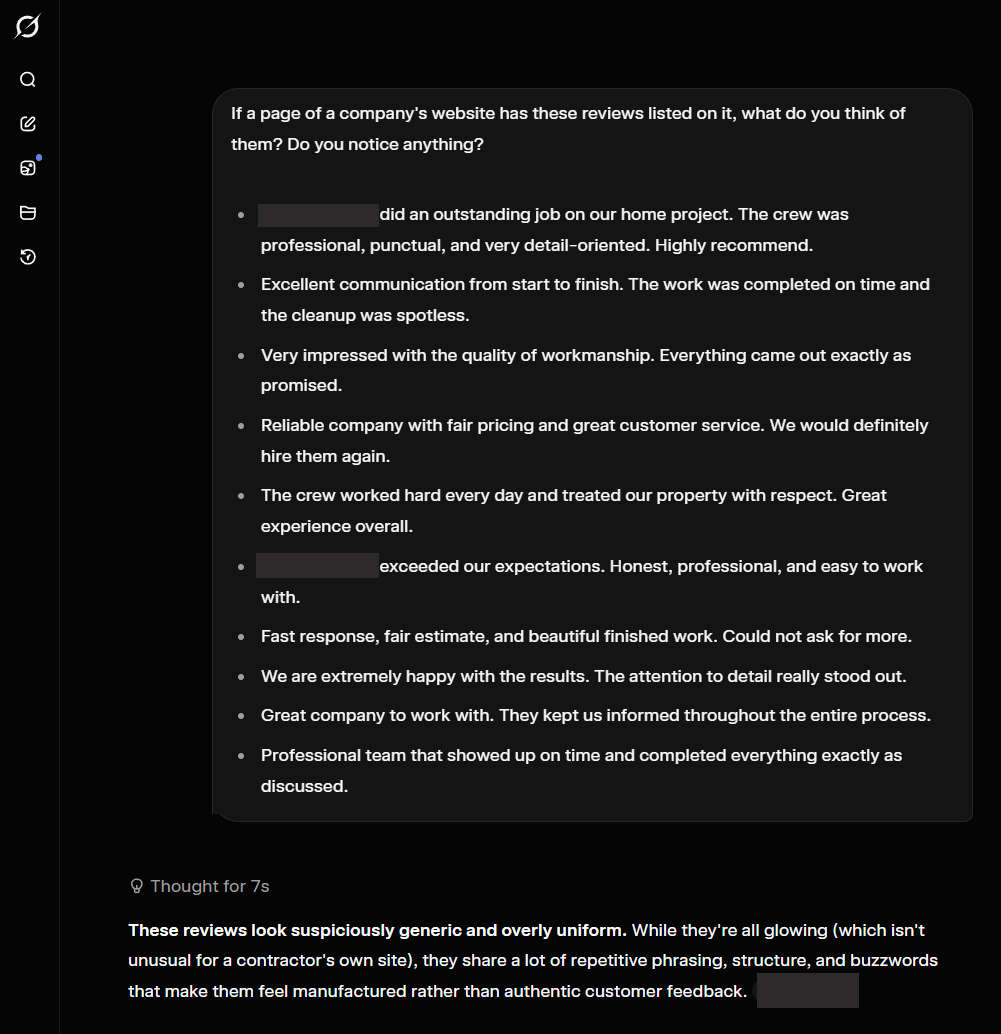
When he asked us to put these on his website, we told him it was a terrible idea. But, hey, maybe we’re a bunch of know-nothing clowns, right? Well, we went back to the source and handed a sample of 40 of the reviews (from the 100 he provided) and asked several AI systems what they thought.
ChatGPT flagged them as suspicious in four seconds.
Grok did the same in seven seconds.
Gemini gave a very similar response, saying its skepticism radar would go off immediately and warning that the reviews looked templated, artificially generated, or heavily curated.
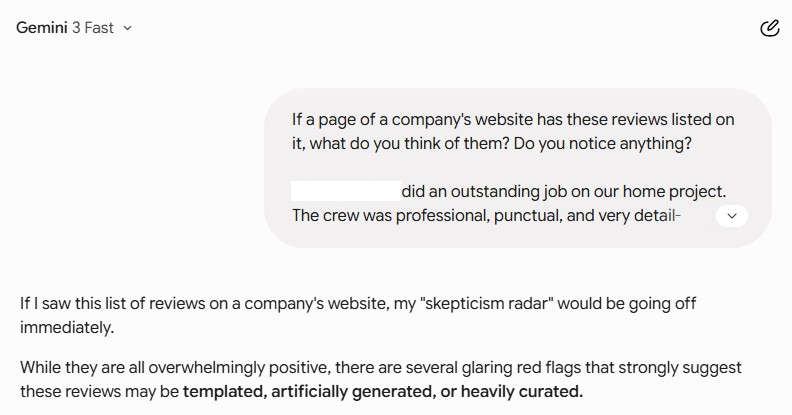
In other words, no one was fooled.
What is the goal here?
There’s only 2 reasons to spend time on reviews:
- Getting better rankings from search engines and AI systems
- Convincing real people to trust your business enough to hire you
Sadly, fake AI-generated reviews fail at both jobs. They do not build trust with real people, and they do not send the kind of credibility signals machines are looking for. In many cases, they can leave you worse off than if you had posted no reviews at all.
Again, don’t take our word for it… ChatGPT even agrees that this is a terrible idea.
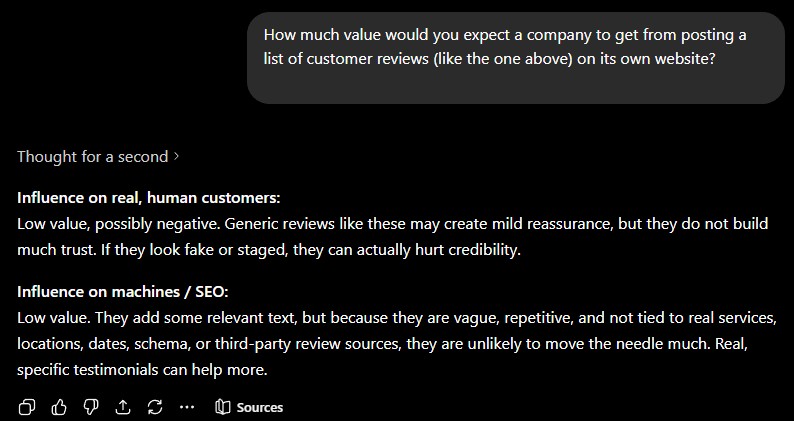
Fake reviews make you look dishonest, and people can spot the con a mile away. So if this fails with the machines and fails with the humans, what exactly is the point?
This tactic does not solve a ranking problem. It does not solve a trust problem. It just creates a new credibility problem that did not need to exist.
Why fake reviews on your own website are especially weak
Even real testimonials on your own website come with limits.
People know you control your own site. They know you are not going to feature a nasty one-star review right on your homepage. So when visitors see customer praise on a business website, they already take it with a grain of salt.
That does not mean on-site testimonials are useless. They can still support a good impression. They can still reinforce your experience and the kinds of jobs you handle. But they are naturally less persuasive than reviews on platforms you do not control.
That is why reviews on places like Google Maps, Yelp, Angi, and similar third-party platforms carry more weight. Those platforms feel more independent. The feedback appears less staged because the business does not fully control what shows up there.
So think about how backwards this is. On-site reviews already start from a position of lower trust. Filling that space with AI-generated fake praise makes an already cautious format look even less believable.
Will this help you rank better?
Almost certainly, no.
Again, this comes back to the principle from our earlier post. If a tactic is extremely easy to do at scale, it is usually not something search systems can rely on as a strong quality signal. That is especially true when the content can be generated in seconds by anyone with a prompt box and an internet connection.
At best, those reviews are ignored as low-value fluff. At worst, they contribute to a bigger picture that makes your site look staged, low-trust, or manipulative.
Either way, this is not an SEO win. It is not some hidden AI visibility hack. It is just easy content pretending to be evidence.
Will this make humans trust your business?
No. And for small businesses, that is a huge problem.
If someone is hiring a plumber, electrician, HVAC contractor, roofer, or remodeler, they are not making some casual little purchase. They are deciding who gets access to their home, their time, and their money.
Trust matters.
If your review page feels fake, that trust starts leaking out fast. A visitor may not be able to explain exactly why something feels off, but they do not need to. Once they suspect the testimonials are staged, the damage is already done.
Now instead of looking established and credible, you look like someone trying to manufacture the appearance of a good reputation without actually earning one.
That is not just bad marketing. It is the kind of thing that can make a homeowner wonder what else you are willing to fake.
This is not a clever loophole
There is always somebody who thinks changing the wording changes the reality.
“Fake reviews” becomes “sample reviews.”
“Made-up testimonials” becomes “website copy.”
“Deceptive customer praise” becomes “inspiration.”
Come on.
If the goal is to present invented customer feedback as though it reflects real customer experience, the label does not matter. The idea is still bad. The tactic is still dishonest. And the result is still likely to make your business look worse, not better.
This is not some brilliant prompt-engineering trick. It is just a shortcut. And like most shortcuts in marketing, it looks a lot less impressive once everyone can see it.
This may also create legal exposure
“Fake” does not become safe because you call it “sample,” “inspiration,” or “website copy.” If a made-up testimonial is presented as real customer feedback, that is the problem.
The FTC’s rule on consumer reviews and testimonials went into effect October 21, 2024. It addresses deceptive review practices, including fake reviews and testimonials, and the FTC says civil penalties can apply for knowing violations.
The FTC also specifically says the rule covers reviews that misrepresent that they are by someone who does not exist, including AI-generated fake reviews, or by someone who did not have actual experience with the business.
That changes the tone here. This is not just dumb marketing. It could also cost you money.
What businesses should do instead
The boring answer is still the right one. Get real reviews from real customers. Ask consistently. Ask soon after the job is done. Make it easy for satisfied customers to leave feedback on the third-party platforms people actually trust.
Then, if you want to highlight testimonials on your own site, use real customer feedback. Quote real experiences. Keep it honest. Let those testimonials support your credibility instead of trying to create credibility out of thin air.
Yes, that takes more effort. That is exactly why it has more value.
The bottom line
Do not do this. Do not ask AI to generate fake reviews for your website. Do not pretend changing the wording makes the trick invisible. Do not assume customers will not notice. And do not assume search engines or AI systems will be impressed.
ChatGPT spotted the problem in about four seconds. Grok spotted it in about seven. Gemini reached the same conclusion too. A sample of 40 reviews from a batch of 100 was enough to set off alarm bells.
If your marketing tactic fails the algorithm test and the human test, it is not a tactic. It is a mistake.
Fake reviews on your own website do not help you rank better. They do not make people trust you more. They fail on both goals.
So why are you bothering with this?
AI Optimization FAQs