
TL;DR
Check-360 is a practical website audit tool built for internal use and now available publicly. Check-360 evaluates on-page, off-page, reviews, and AI-readiness, and offers free and paid tiers to fit different needs.
- Check-360 uses a pass / warn / fail system with color-coded severity so you can focus on critical fixes first.
- Check-360 Lite is free for a one-page scan; Standard reviews up to 50 pages; Plus adds prioritized guidance, 30-day quick wins, and competitor analysis.
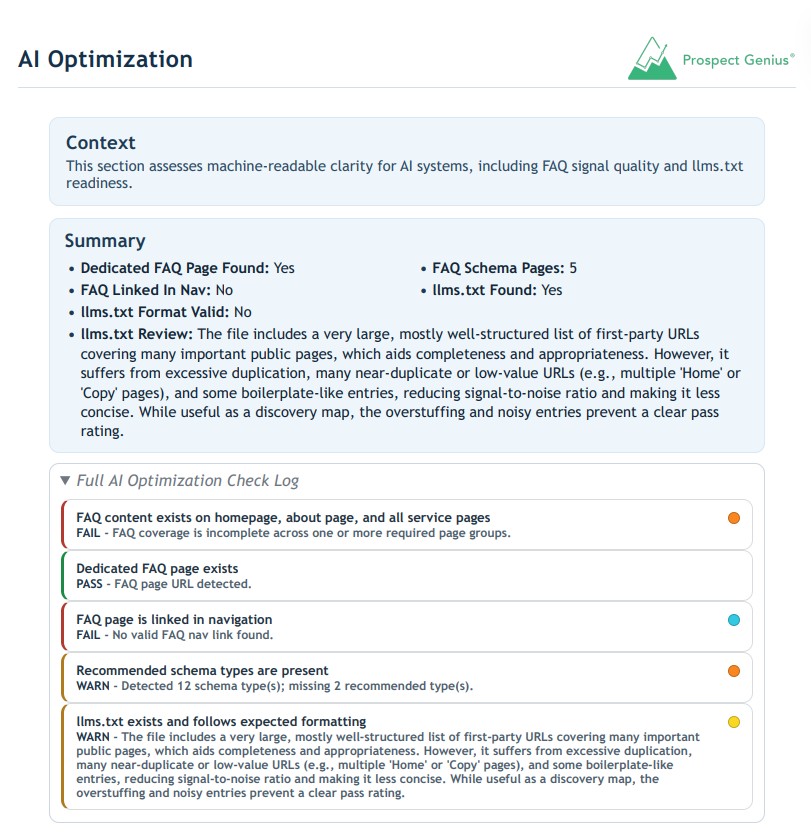
- Check-360’s AI Optimization section checks AI-readiness metrics and the newer site elements that help AI systems recommend your business.
Quick win: Run the free Lite scan and fix any items marked critical by Check-360 first.
There is no shortage of free website checkup tools online. Search for a website audit tool, and you will find plenty of options promising to scan your site, score your SEO, and show you everything that needs fixing. Sometimes those tools are helpful. But in many cases, they are also part of a sales funnel.
That creates an obvious incentive. If the goal is to sell you services, the tool has every reason to make your site look worse than it really is, or at least make the problems feel more urgent than they may be.
We have written before about how many SEO audit tools walk the line between useful analysis and sales tactic. You can read that article here.
That is exactly why we released Check-360.
Check-360 is not a tool we invented just to attract leads. It is a tool we built for our own internal use and still use today when researching websites for clients and prospects. We are simply making it available to the public because business owners deserve a more straightforward way to evaluate where they stand.
We do offer a free version so you can try it out, along with inexpensive paid upgrades. That part is not hidden. The paid options simply help support the cost of maintaining and improving the tool.
Why This Matters More Than Ever
For small business owners, visibility online is getting harder to earn. Google keeps squeezing organic results with more paid placements and AI-generated answers. At the same time, users are branching out to tools like ChatGPT, Claude, Perplexity, and Grok for recommendations and answers.
That means visibility is becoming more fragmented and more competitive. The businesses that win will be the ones that master strong SEO fundamentals and adapt to newer AI-facing signals too.
We have already written about how to get AI systems to recommend your business, and the short version is this: you still need strong SEO fundamentals, but now you need to execute them at a higher level and support them with a few AI-specific elements as well.
The challenge is knowing where to start. That is one of the main problems Check-360 was built to solve.
What Makes Check-360 Different?
The biggest difference is simple: this is the real internal tool.
It was not designed to frighten you into booking a call. It was built to help us evaluate websites more clearly, spot real weaknesses, identify strengths, and prioritize what matters most.
That means the report is designed to be practical. It helps you see where your site is doing well, where it is falling short, and where your time and budget should go first.
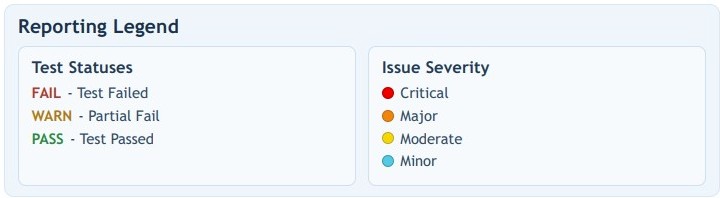
We use an easy-to-read pass / warn / fail system so you can quickly understand what needs attention. We also color-code the severity of each issue. If something is marked critical, that is your clearest place to start.
What the Report Helps You See
One of the most useful things about Check-360 is that it does not just hand you a scary score and leave you there.
It helps you see both the weak spots and the strong ones. Maybe your content is solid but your reviews are weak. Maybe your reviews are strong but your on-page structure needs work. Maybe your SEO basics are decent, but your AI-readiness is lagging.
That kind of clarity helps you avoid wasting time and money on the wrong fixes.
What Is Included in Each Section?
1. On-Page Analysis
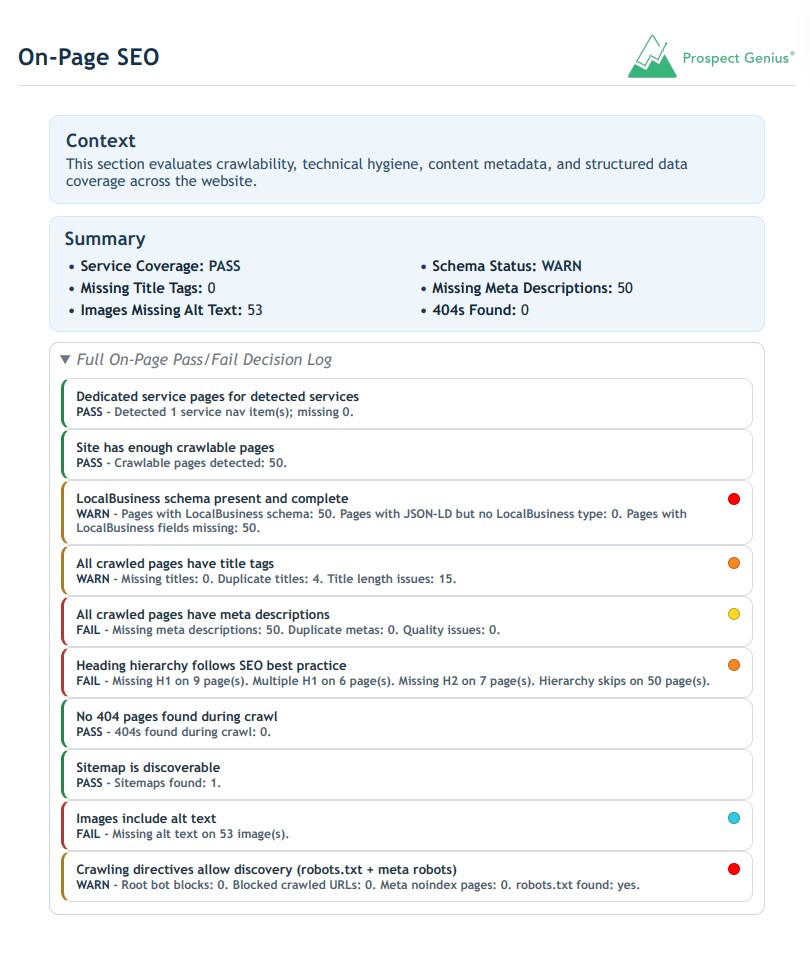
The On-Page section focuses on the parts of your website that live directly on your site.
That includes the words on the page, the images, the layout, and the structure of your content. These are the elements that help search engines, AI tools, and human visitors understand what your business does and why the page matters.
If a page is thin, unclear, poorly structured, or missing important elements, this section helps reveal that quickly.
2. Off-Page Analysis
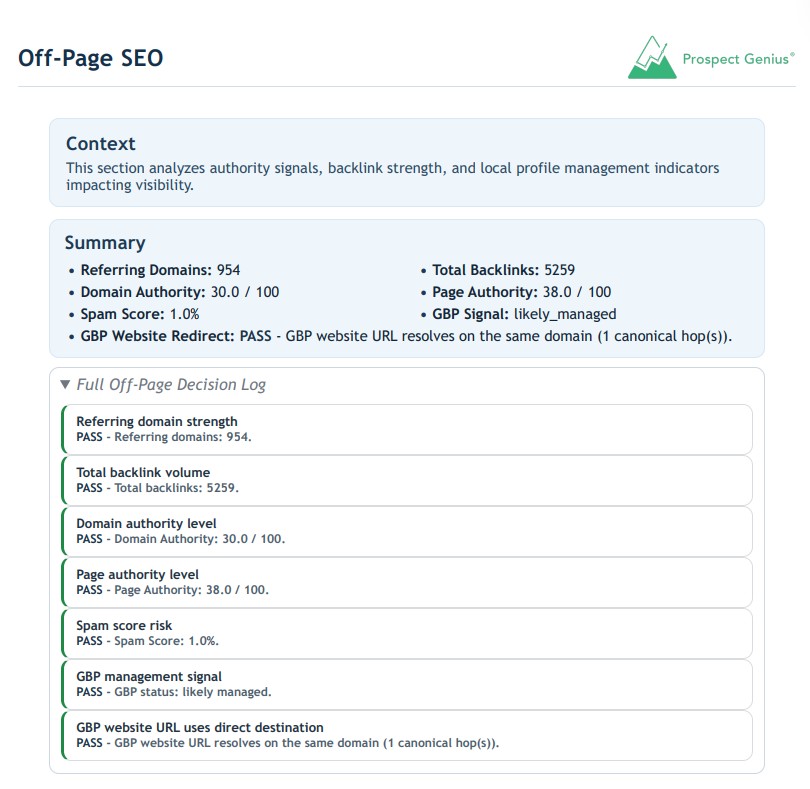
The Off-Page section looks at signals that come from outside your website.
This includes links from other sites, mentions of your business, and other reputation-related indicators. Think of this as your site’s external credibility. Your website can say great things about you, but off-page signals help show whether the wider web agrees.
For local businesses, that kind of reputation can directly affect visibility.
3. Review Analysis
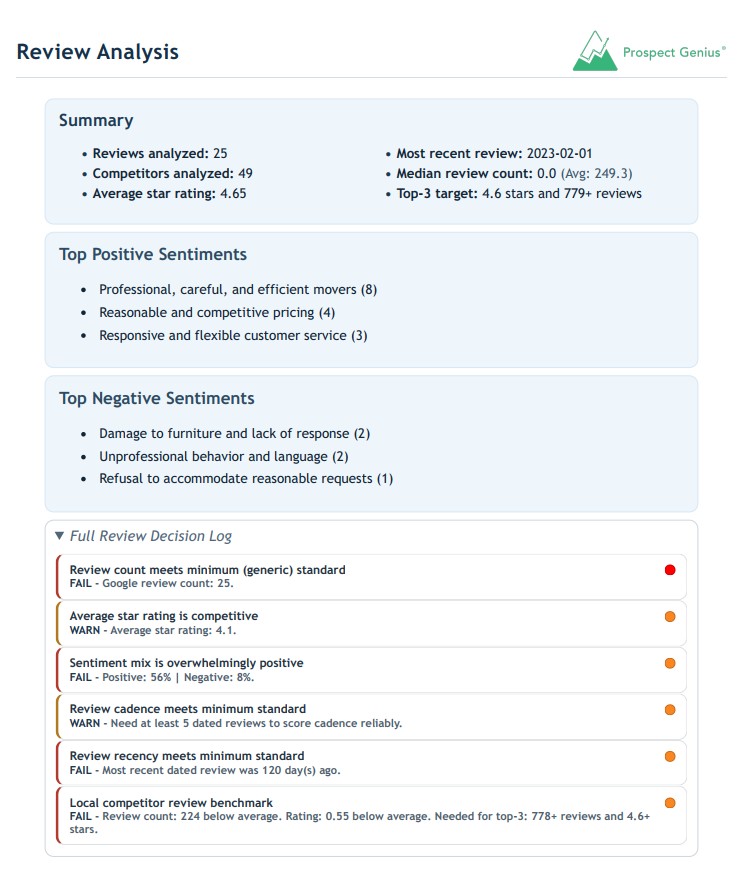
The Review Analysis section looks at your customer reviews to see what is working, what is not, and how you stack up against others.
This section helps you understand your review profile and shows how many reviews and what average star rating you may need to break into the top three on Google Maps.
For many businesses, this section reveals a major opportunity. If your reviews are lagging behind top competitors, that can hold you back even if other parts of your marketing are solid.
4. AI Optimization
The AI Optimization section focuses on the newer signals that help AI systems understand and recommend your business.
It checks for AI-readiness metrics, looks for the newer site elements needed to support AI recommendations, and reviews whether those elements are structured properly.
AI visibility is not separate from SEO. It builds on it. If you want AI systems to recommend your business, your site needs strong fundamentals, clear structure, and the right supporting signals.
Three Levels of Check-360
You can see a full comparison in the table on the Check-360 page, but here is the quick version.
Lite is free. It gives you a quick look at one page of your site and provides a simple starting point if you want to see where you stand.
Standard gives you access to all sections and can review up to 50 pages of your site. This creates a much more complete picture of your website and online presence.
Plus includes everything in Standard, plus guidance on the top issues to tackle first, possible 30-day quick wins, and competitor analysis so you can see how you stack up in your market.
You can start for free, and if you want deeper analysis, the upgrade path is there. The idea is simple: provide a useful tool, then use the paid versions to help support the cost of keeping it available.
Final Thoughts
If you are going to use a website audit tool, it is worth asking a simple question: what is this tool actually trying to do for me, and what is it trying to do for the company behind it?
That question is a big part of why Check-360 exists.
Check-360 shows you what is working, what is holding you back, and what to fix first, without turning a website audit into a scare tactic.
AI Optimization FAQs