
TL;DR
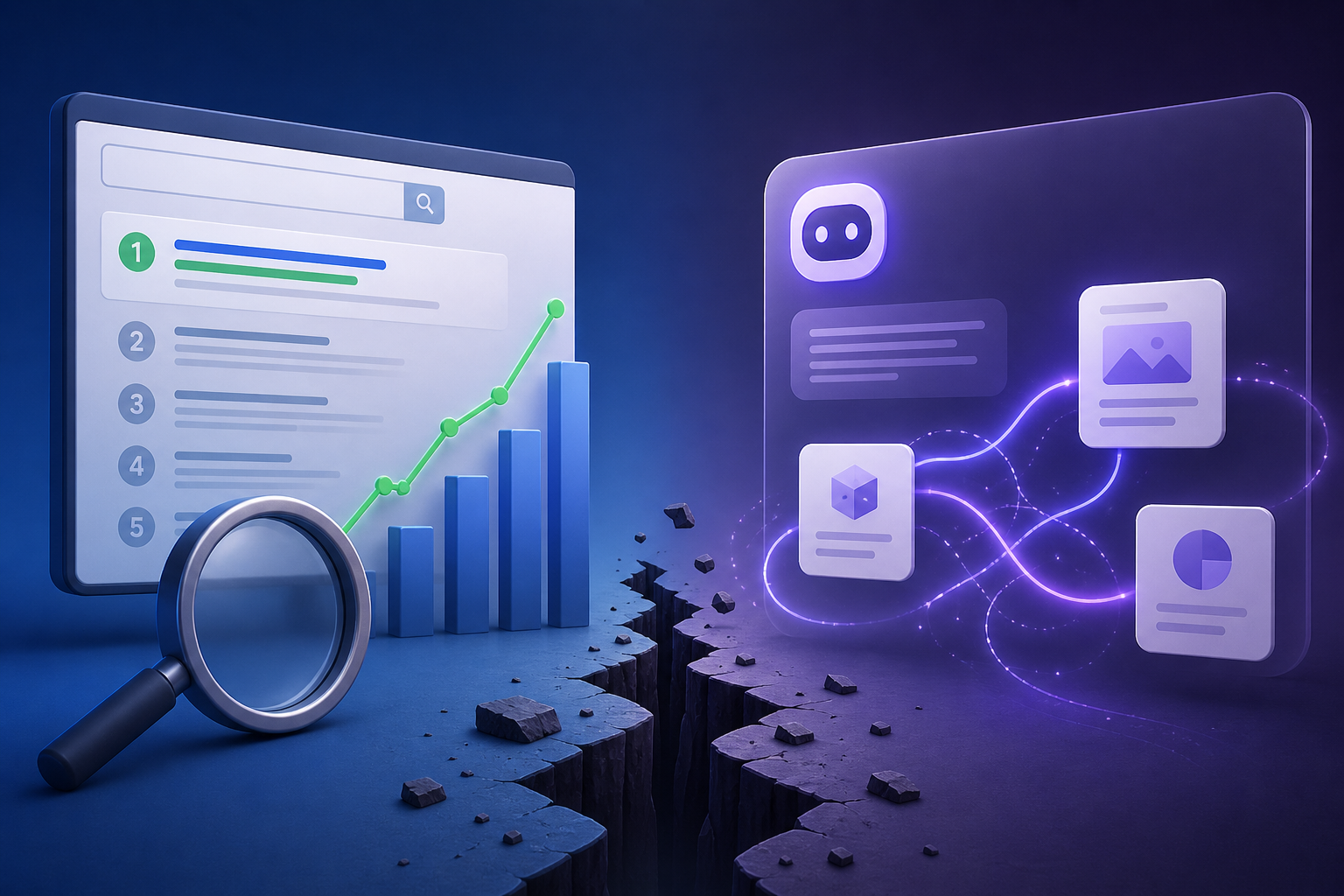
AI visibility matters, but AI rank tracking is not a simple, stable, universal metric.
- AI answers can change based on prompts, prior conversations, user context, model behavior, and personalization.
- AI-related traffic trends and AI bot activity provide a more grounded way to monitor visibility over time.
- Manual AI checks can be useful, but they should not outweigh leads, conversions, branded search, and real traffic trends.
Quick win: Focus on making the business more recommendable with clear service pages, accurate business information, strong reviews, visible expertise, local relevance, and trustworthy mentions.
“You keep using that word. I do not think it means what you think it means.”
That line from The Princess Bride fits a lot of the talk around “AI rank tracking” right now.
More and more companies are suggesting they can track your business inside AI tools the way SEO platforms track keyword rankings in Google. That sounds clear and familiar. The problem is that the phrase starts to fall apart as soon as you ask what is actually being measured.
Some of it is useful. Some of it is being dressed up to look more precise than it is.
That is the real issue. AI visibility is worth paying attention to. But the idea that there is a simple, universal, trackable “AI rank” for your business is being oversold right now.
What we prefer to track instead
Rather than pretending we can calculate a perfect AI rank, we prefer to track something more concrete: AI-related traffic trends.
For our clients, we watch visits from AI users and AI bots over time. By AI bots, we mean crawlers and automated systems from AI platforms that access site content. We want to see the trend moving in the right direction for both human traffic and AI platform activity.
That gives us a more grounded view of whether AI visibility is actually improving. It is not perfect, but it is more reliable than trying to guess where a business “ranks” inside a personalized, context-heavy system.
This level of detail is not always available in standard analytics packages, which is why we built it into our own reporting. We mine server log data for it because that is the most reliable number we can get.
Why this matters
People really are using AI tools to research businesses. Business owners check them. Marketers check them. Prospects check them.
That means it is completely reasonable to look at whether your company gets mentioned, how it gets described, and which competitors show up around it. The problem is not the act of checking. The problem is treating those checks like a clean ranking system.
Even search rank tracking was never perfect
This problem did not start with AI.
Even traditional search rank tracking had limits because search results were never as universal as people wanted them to be.
A business owner might say, “I’m not ranking in that city.” Meanwhile, the rank tracker says they are. In many cases, both are right.
The tool may be measuring a neutralized version of results. The business owner may be seeing a personalized version shaped by location, browsing history, account state, previous searches, device signals, or session behavior.
That gap caused confusion for years in SEO. Rank tracking was still useful, but it was always an approximation of visibility under controlled conditions, not a perfect copy of what every person saw.
The “belts” example explains personalization fast
Say John and Jane Doe both search for “belts.” John is a mechanic. Jane is a fashion designer.
John’s search history is full of automotive content. Jane’s history is full of clothing and accessory research. Even though they typed the same word, Google has to figure out what each person probably means. For John, that may be an engine belt. For Jane, it may be something to wear around her waist.
That is personalized search doing its job.
The important lesson is simple: two people can type the same query and still not be asking the same thing in the eyes of the platform.
AI takes that personalization problem much further
Search engines have long used history and context to interpret intent. AI assistants can go much further.
If someone has been using an AI tool for weeks or months, that system may know a lot about them. It may understand their preferences, budget concerns, priorities, past questions, and the kinds of answers they usually want.
That means the final recommendation may be shaped by much more than one prompt. The available context can include a long trail of past conversations, decision patterns, and preferences.
That is a major difference. A search engine might infer intent from visits, clicks, and session behavior. An AI assistant may be able to look back at earlier conversations and see how the user worked through a problem, what options they considered, what mattered most in the final decision, and what kind of outcome they chose.
A homeowner might not just ask, “Who is the best HVAC company near me?” They may have already talked to the AI about their AC freezing up, what they tried first, when they gave up, how urgent the problem is, and whether price matters more than speed, reputation, or financing.
If the last time they tried to fix something themselves they failed, then hired someone based mostly on price, the AI may treat that as a meaningful pattern. It may reasonably guess that this person is likely to make a similar choice again.
By the time the AI recommends a business, it is responding to much more than a simple local search. Two users can ask similar final questions and still get very different answers.
Why simple “AI rank tracking” breaks down
Traditional rank tracking works because there is at least a somewhat stable thing being measured: where a site appears in a list of search results for a query.
AI often does not give you that kind of fixed list. It gives you a generated answer.
That answer may change based on the wording of the prompt, the prior conversation, the user’s account, the model being used, the user’s history with the tool, or simply because generative systems do not always produce the same output every time.
You can repeat the same query several times and get different wording, different examples, different citations, and sometimes different business recommendations altogether.
That means the instability is not just caused by personalization. It can also come from the basic nature of how these systems generate answers.
So when someone talks about “AI ranking,” the obvious question is: what exactly are they tracking?
- Whether your business is mentioned at all?
- How early it is mentioned?
- Whether your site is cited?
- Whether the mention sounds positive?
- Whether you are still recommended after follow-up questions?
Those are very different things. That is one reason many “AI rank tracking” claims sound more precise than they really are.
Another limit is cost
Unlike traditional search scraping, large-scale AI testing is not free.
AI systems run on tokens, and tokens cost money. If someone wants to run thousands of prompts across different businesses, locations, and models every day, that cost adds up quickly.
So when companies talk as if they can track AI visibility at massive scale with perfect reliability, that should raise questions.
What is actually possible
A company can create a fixed set of prompts, test them across specific models, use clean sessions, and record whether a business gets mentioned. That can reveal patterns over time.
That kind of testing can be useful. But it is still a lab-style benchmark, not a clean picture of real-world behavior for every user.
A controlled prompt test cannot fully reproduce memory, prior chats, account-level personalization, user preferences, or the many different ways real people ask questions.
So yes, AI visibility can be measured in pieces. No, that does not make it a universal, real-world ranking metric.
Where AI checks belong
Manual AI checks still have value. They can show whether your brand appears, whether your services are understood correctly, whether bad information is showing up, and which competitors keep surfacing.
That makes them worth looking at. But they are weak signals. They can inform decisions, not dominate them.
A few prompts should never outweigh stronger evidence from leads, conversions, branded search, and real traffic trends.
The better goal
The better goal is not to “track AI rank.” It is to improve how recommendable your business is.
That means building the kinds of signals AI systems and search systems both rely on: clear service pages, accurate business information, strong reviews, visible expertise, real local relevance, and trustworthy mentions across the web.
AI visibility is worth watching. It just is not clean enough to treat like traditional rank tracking.
The bottom line
It is completely reasonable to check whether your business shows up in AI answers.
What is not reasonable is pretending those checks produce a simple, stable, universally accurate ranking metric.
They do not.
Look at AI visibility. Learn from it. Track real traffic trends when you can. Just do not mistake a loose signal for a hard number you should bet the farm on.
AI Rank Tracking and AI Visibility FAQs